**Ningbo Topcentral New Materials Co., Ltd.: Striving to Be a Global Leader in Low-Carbon Circular New Materials**
What connects a brand-new T-shirt and a discarded plastic bottle, or a new hat and an abandoned fishing net? The answer lies within the factory of Ningbo Topcentral New Materials Co., Ltd. (hereinafter referred to as “Topcentral New Materials”).
Topcentral New Materials is a high-tech enterprise specializing in the R&D and technical services of sustainable and low-carbon functional materials, new material modification, and bio-based and biodegradable materials. Integrating R&D innovation, testing and analysis, production, sales, and technical services, the company provides customers with professional, high-performance, functional, and customized system innovation solutions for new materials.
Amidst increasingly severe global climate change and environmental issues, pursuing environmental protection and sustainable development has become a consensus among global enterprises. To address the growing problem of plastic pollution, Topcentral New Materials focuses on the recycling and utilization of low-carbon circular materials, continuously exploring new pathways for carbon reduction, carbon decrease, and a zero-carbon economy.
**Exploring the “Topcentral Solution” for Sustainable Development**
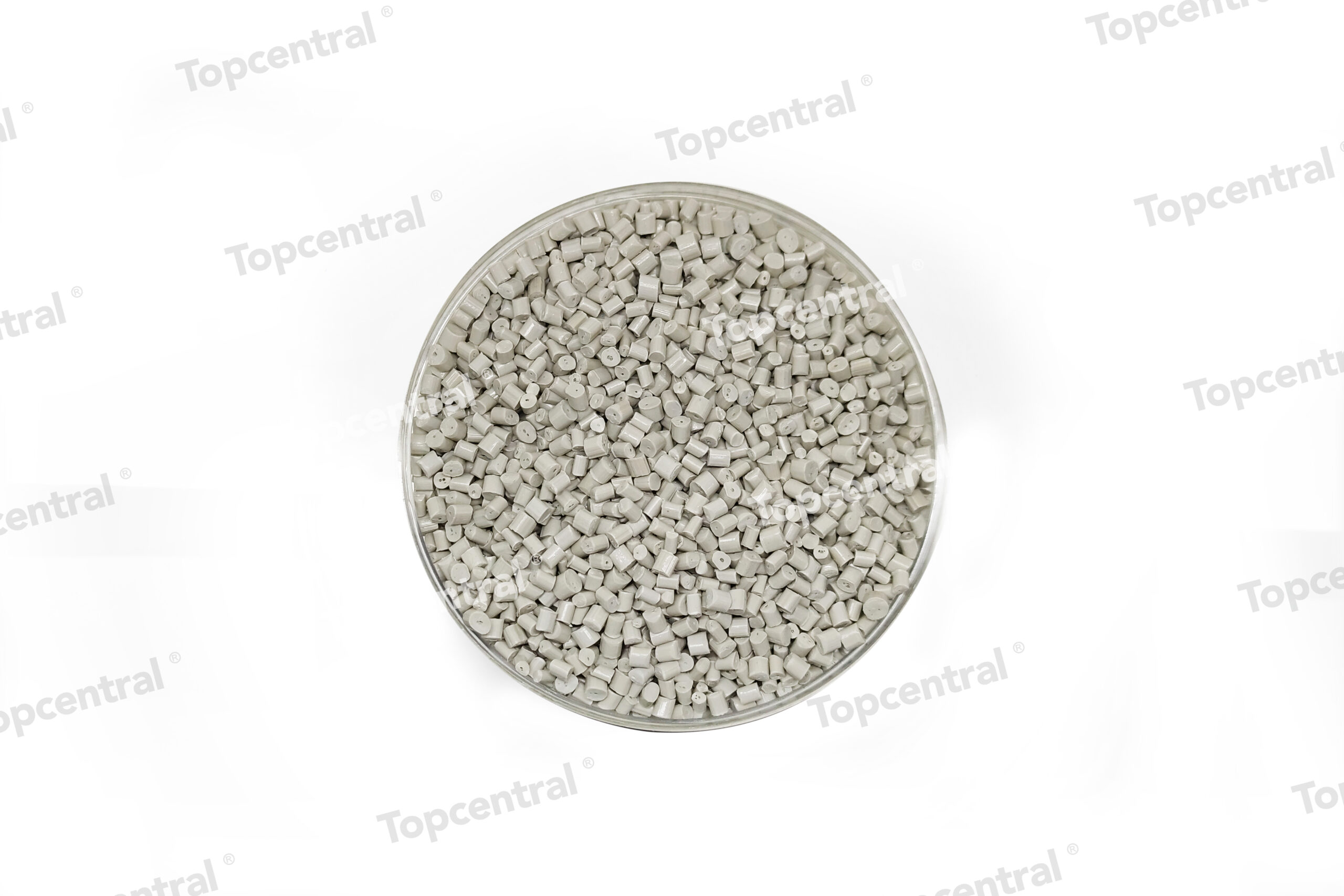
In the Binhai New Area of Fenghua Economic Development Zone, plastic waste awaiting processing is neatly stacked outside Topcentral New Materials’ factory buildings. Inside, the roar of machinery fills the air as plastic pelletizing production lines operate at full speed. Plastic bottles, fishing nets, marine buoys, discarded household appliances… Here, plastic “waste” becomes “treasure.” Through processes including melting, pelletizing, and cutting, it is “reborn” into uniformly sized recycled plastic pellets. These unassuming small pellets are the raw materials for various products such as clothing, bags, and cultural creative items.
Founded at the end of 2019, Topcentral New Materials envisions becoming a functional professional platform driven by digitalization, technological innovation, and talent synergy, aiming to grow into a pioneering enterprise in the circular economy sector. Despite facing numerous challenges during the early stages of the pandemic, the company officially commenced production in March 2020.
The company’s founder and CEO, Ma Yiming, holds a bachelor’s and master’s degree in Polymer Chemical Engineering and is currently pursuing a doctoral degree. Before founding Topcentral New Materials, Ma Yiming accumulated 15 years of industry experience working in petrochemicals, modified plastics, and recycled plastics at Fortune 500 companies, state-owned enterprises, and private enterprises. It is this professional experience that allowed him to recognize the immense potential of the circular economy.
“As society and the economy continue to develop, finite earth resources are gradually being depleted. The circular economy will undoubtedly become one of the main themes of future industries. Currently, the world consumes at least 400 million tons of plastic annually, a figure that could grow to 1 billion tons or more in the future. If these resources are recycled, it will form a massive plastic regeneration market,” said Ma Yiming. Based on this insight, he decided to dedicate himself to the R&D and manufacturing of green, low-carbon circular materials.
Since its establishment, focusing on the R&D and manufacturing of sustainable and low-carbon functional materials, new material modification, and bio-based and biodegradable materials, the company has formed four major product lines: Topcircle®, CircleBlend®, Bydercom®, and Chemcircle®. The Topcircle® product line further includes various brands and technical services such as General Plastics Series (TCycleGP®), Engineering Plastics Series (TCycleEP®), Specialty Plastics Series (TCycleSP®), Thermoplastic Elastomers (TCycleElast®), and 3D Printing PCR Additives (TCycleAM®), covering nearly all categories of plastics. These high-performance recycled materials are widely used in fields such as 5G fiber optic communication, consumer electronics, the automotive industry, household daily chemicals, and apparel.
**”Ocean Partner” Initiative Aiding Ecological Environment Improvement**
At the Qifeng Village Pier, not far from the company, the “Ocean Partner” Eco-Cabin yields new “harvests” daily. Initiated and led by Topcentral New Materials, this eco-cabin was officially put into operation in July last year. Covering over 600 square meters, it is constructed from several discarded shipping containers and features a smart marine waste collection cabin. Villagers from Qifeng Village have become regulars. By simply tapping the screen and depositing old fishing nets, used fish crates, bottles and cans, or even waste oil from fishing boats, they earn corresponding carbon credits. These credits can be exchanged for cultural creative products made from recycled plastics, beverages, snacks, and more.
Since the “Ocean Partner” Eco-Cabin has been operating for over a year, villagers have gradually developed the “habit” of recycling waste. To extend the recycling initiative, Topcentral New Materials has also established several “Hai Su Xiao Zhan” (Marine Traceability Stations) in villagers’ homes, facilitating nearby residents to deposit marine waste and extending the collection system throughout the villages. After being sorted at the “Sea Hi Recycling Station,” this waste is uniformly transported to Topcentral New Materials’ pre-processing plant and production workshops.
Where do the “wandering” marine wastes go after arriving at their “new home”? “A sun-protective jacket, made from 100% rPA6 recycled material, can reduce carbon emissions by 1515.9 grams, water consumption by 260.9 grams, and waste pollution by 234.6 grams; an electric toothbrush, made from 100% rABS recycled material, can reduce carbon emissions by 78 grams, water consumption by 624 grams, and waste pollution by 24 grams…” Ma Yiming enumerated these “treasures” one by one. These cultural creative products, manufactured from recycled materials, are endowed with exclusive carbon codes. This is a traceability chain technology product based on a full lifecycle digital gene editing and decoding technology (iDNAxX). Users can scan the carbon code to identify the product and learn about its origin.
“Although recycled marine waste accounts for only 10% of the company’s total recycled materials, its volume has reached over 1,000 tons,” said Ma Yiming. “Through plastic recycling and regeneration technology, we turn marine waste into treasure, producing widely applicable recycled plastic pellets that generate revenue. This revenue covers the entire collection system, logistics system, and processing and R&D system, forming a sustainable industrial chain.” Currently, Topcentral New Materials has developed multiple marine plastic recycled pellets and finished products, including rPET (TC-Rester®), rPE (Poisye®), and rABS (IBISS®), which are sold domestically and in international markets such as Europe, America, and Southeast Asia.
**Innovation-Driven, Entering the “Fast Lane” of Development**
In November 2024, Topcentral New Materials won the Third Prize of the Zhejiang Provincial Science and Technology Progress Award; in September of the same year, the company established a strategic cooperation with SABIC, the largest petrochemical manufacturer in the Middle East, and was selected for the “Golden Seed” Plan National Model Cultivation Database; in June 2023, as one of only two private enterprises globally, it received the China-Europe Carbon Neutrality Innovation Demonstration Award; in October 2022, it became the world’s first enterprise to obtain “dual” carbon neutrality certification at both the product and organizational levels…
Behind this rapid growth lies Topcentral New Materials’ emphasis on and pursuit of technological innovation. Since its inception, the company has continuously increased R&D investment and improved its intellectual property system. The company has assembled a highly educated, experienced, and innovative talent team, with employees holding bachelor’s degrees or above accounting for 60%, and R&D personnel accounting for nearly half. Simultaneously, the company actively collaborates with domestic universities and research institutes such as the Chinese Academy of Sciences, Tianjin University, Zhejiang University, and Zhejiang University Ningbo Institute of Technology, engaging in industry-academia-research cooperation to overcome critical technical bottlenecks in circular economy materials.
Currently, the company holds numerous independent intellectual property rights, covering aspects such as new material R&D and production process optimization. It possesses 67 patents, with invention patents accounting for over 50%. The company has formulated and published 3 national standards, with a 4th national standard currently under project initiation; it has formulated and published 2 group standards, with 2 others under drafting and initiation; and it has been granted 287 trademarks.
“Low-carbon circular materials often require performance reduction to achieve recycling. However, through advanced recycling technologies, AI algorithms, ultra-clean filtration technology, and special functional modification techniques, we have successfully achieved material performance stability and same-level regeneration, expanding their application scenarios and boundaries,” Ma Yiming said proudly regarding the company’s innovative technologies.
“Depending on the material and process, green low-carbon circular materials can achieve approximately 60% to 95% carbon reduction effects, making a positive contribution to addressing global climate change. Furthermore, circular materials can effectively reduce the extraction and use of earth’s resources and energy, contributing to sustainable development,” Ma Yiming stated. “In the next step, Topcentral New Materials will continue in-depth research into physical recycling and chemical recycling technologies, while exploring new application areas for biodegradable materials. Within the next decade, we strive to become a global leader in low-carbon circular materials and achieve an IPO before 2030. At the same time, we look forward to joining hands with more partners to jointly promote the vigorous development of the circular economy.”
Leave a Reply